Translating precision neuromodulation from clinic to market.
Synaptiq Neurotech develops and commercializes proprietary neuromodulation technologies — next-generation TMS designed for precision, adaptability, and real-world clinical deployment.
of people with depression fail to respond adequately to two or more antidepressant trials.
patients in whom conventional scalp-based targeting misses the intended cortical target.
effect size favoring individualized targeting over scalp-based targeting in a randomized trial of accelerated TMS.
Sources: McIntyre et al., World Psychiatry (2023) · Mir-Moghtadaei et al., Brain Stimulation (2015) · Taylor et al., JAMA Psychiatry (2026). These figures describe the published transcranial magnetic stimulation literature generally and do not represent outcomes of Synaptiq Neurotech technologies.
Legacy TMS treats every brain the same.
Depression is the leading cause of disability worldwide, and at least a third of patients do not respond adequately to standard antidepressant therapy. TMS is FDA-cleared for exactly these patients — but the way it is delivered has not kept pace with the science.
Targets are located using scalp measurements that miss the intended region in more than a third of cases. Dose is set from a motor-cortex threshold that does not reliably predict what reaches the prefrontal cortex. And a standard course still means near-daily sessions for roughly six weeks.
The result is a genuinely effective therapy delivered imprecisely — and outcomes that vary far more than they should.
Precision targeting informed by individual patient data, not population averages.
Adaptive dosing that moves beyond fixed, legacy stimulation parameters.
Protocols built for real-world clinical efficiency and reproducible delivery.
The field has already shown what precision unlocks.
In a randomized trial of accelerated TMS, individualizing the stimulation target from a patient’s own imaging produced substantially greater symptom reduction than standard scalp-based targeting — with a number-needed-to-scan of five. Targets proved stable within a person and meaningfully different between people.
The principle is no longer hypothetical: individual anatomy matters, and accounting for it changes outcomes. What is missing is a platform that makes this practical beyond a handful of academic research centers.
Delaware C-corporation · Founded by federally funded clinical investigators · Peer-reviewed research program
Four programs advancing precision neuromodulation.
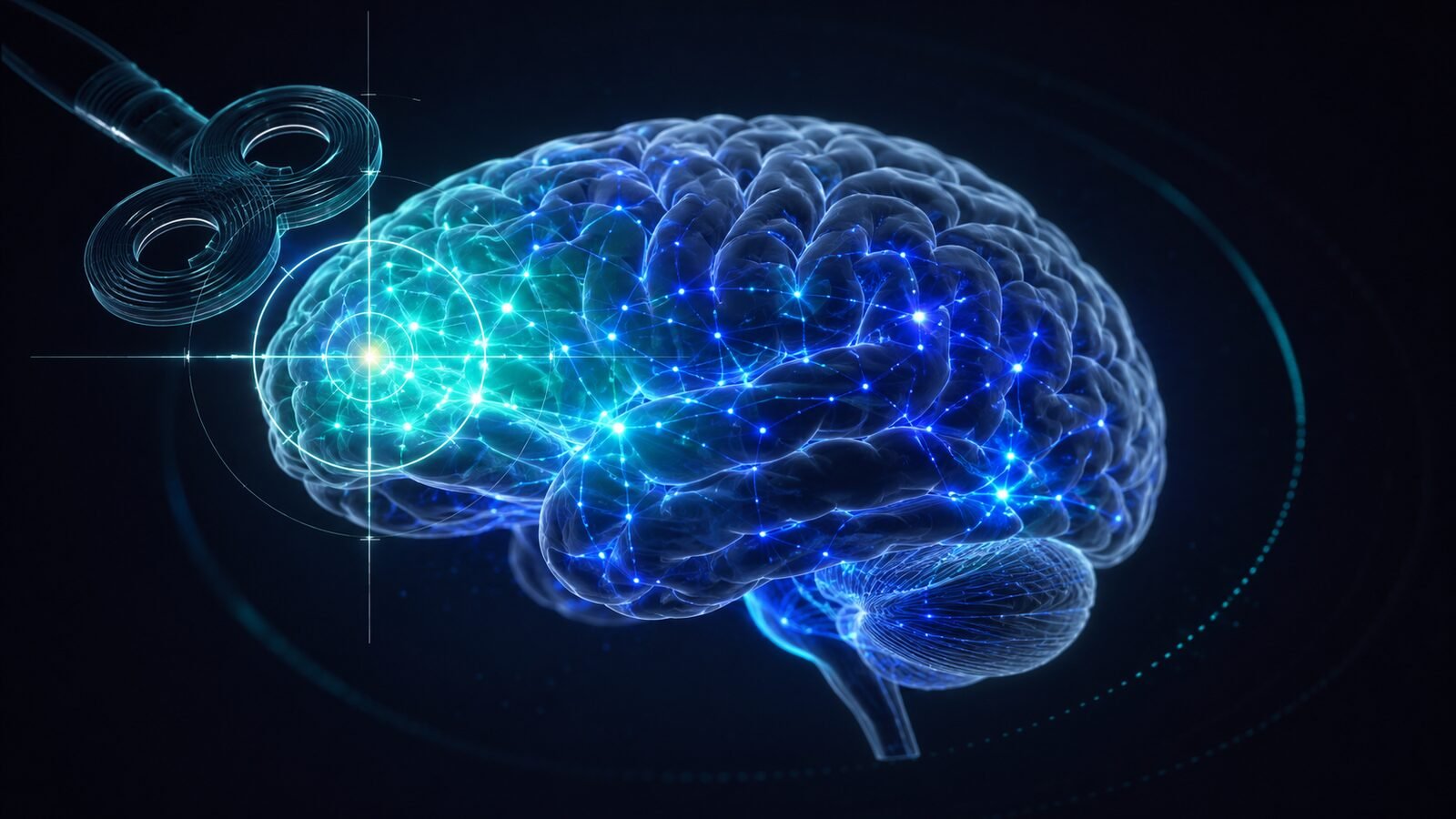
Personalized Targeting & Accelerated Protocols
Precision targeting informed by individual patient data, paired with accelerated treatment protocols built for clinical efficiency.
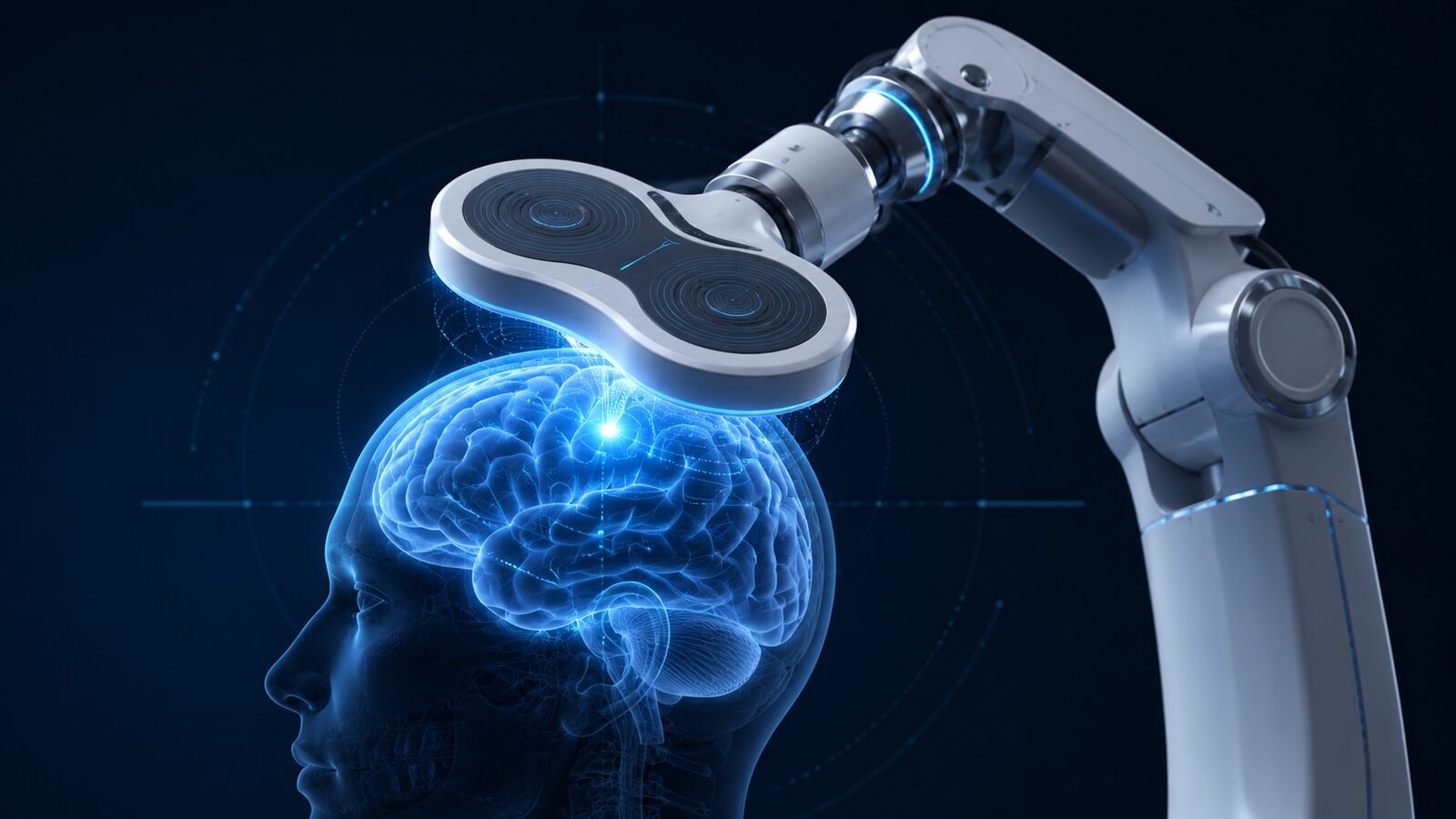
Advanced TMS & Neuromodulation Innovation
Novel stimulation paradigms and dosing approaches that move beyond legacy, one-size-fits-all treatment.
AI Products & Services
Machine-learning tools that support treatment optimization and clinical decision-making.
Immersive & VR Programs
Immersive technologies that enhance patient engagement and therapeutic delivery.
Grounded in peer-reviewed science.
Synaptiq Neurotech’s platform builds on a decade of published research in neuromodulation by its founders and research collaborators.
TMS and Neuroethics
Dubljević & Young (Eds.) — Advances in Neuroethics, Springer / Nature
- 2025Toward inclusive, evidence-based rTMS care for patients with co-occurring substance use disordersAmerican Journal of Psychiatry — Steele, Young, Hanlon et al.
- 2025Effects of transcranial magnetic stimulation on cognitive-affective task-based functional connectivityBrain Connectivity — Addicott, Young & Appelbaum
- 2024Electroconvulsive therapy changes immunological markers in major depressive disorder: a scoping reviewThe Journal of ECT — Young, Evans, Kritzer, Kellner & Weiner
- 2021Transcranial magnetic stimulation treatment for smoking cessation: an introduction for primary care cliniciansThe American Journal of Medicine — Young, Galla & Appelbaum
- 2020Non-invasive brain stimulation for the treatment and prevention of opioid use disorder: a systematic reviewJournal of Addictive Diseases — Young, Smani, Kritzer, Mischel, Appelbaum & Patkar
- 2020Transcranial direct-current stimulation to enhance technical skills training: a randomized controlled trialBrain Stimulation — Cox, Deng, Young, Lisanby & Appelbaum
- 2014Subcranial magnetic stimulation: a novel method of focal, non-invasive deep brain neuromodulation for the treatment of PTSDBrain Stimulation — Young, Rozhkov, Li, Young, Barber & Wallisch
Engineering the science of where and how much.
Co-founder Dr. Moritz Dannhauer’s peer-reviewed research advances the electric-field modeling that underpins individualized neuromodulation.
- 2025Real-time computation of brain E-field for enhanced transcranial magnetic stimulation neuronavigation and optimizationImaging Neuroscience — Hasan, Dannhauer, Wang, Deng & Gomez
- 2025Motor network reorganization associated with rTMS-induced writing improvement in writer’s cramp dystoniaBrain Stimulation — Bukhari-Parlakturk, Mulcahey, Lutz et al.
- 2024A semi-automated pipeline for finite-element modeling of the TMS-induced electric field in nonhuman primatesJournal of Neuroscience Methods — Goswami, Shen, Gomez et al.
- 2024Electric field modeling in personalizing transcranial magnetic stimulation interventionsBiological Psychiatry — Dannhauer, Gomez, Robins et al.
- 2022Fast computational E-field dosimetry for TMS (adaptive cross approximation & auxiliary dipole method)NeuroImage — Wang, Hasan, Dannhauer, Yucel & Gomez
- 2019Conditions for numerically accurate TMS electric-field simulationBrain Stimulation — Gomez, Dannhauer, Koponen & Peterchev
Founded by faculty at Duke University School of Medicine and East Carolina University, with an active, peer-reviewed program of neuromodulation research. Young on Scholar → Dannhauer on Scholar →
Built for partnership.
We work with partners across the neurotherapeutics landscape to bring differentiated neuromodulation approaches from research to market.
Differentiated combination approaches
Evidence-backed neuromodulation strategies designed to differentiate from standard of care in neuropsychiatry.
Translational collaboration
Personalized targeting and accelerated protocols, grounded in a published research program.
A defensible position
A protected IP foundation, clinical validation, an experienced founding team, and a clear product roadmap.
An advanced TMS platform
Next-generation TMS with AI and immersive-technology integration across novel indications.
Synaptiq Neurotech is developing a portfolio of neuromodulation technologies in collaboration with researchers at East Carolina University. IP terms are managed through standard academic research agreements.
Partnership opportunities are available. We welcome conversations with pharmaceutical and strategic partners seeking differentiated approaches in neuropsychiatry.
A founding team at the intersection of medicine and engineering.
 JY
JYDr. Jonathan Young, MD
Board-certified psychiatrist and Medical Assistant Professor in the Department of Psychiatry & Behavioral Sciences at Duke University School of Medicine, and a federally funded clinical investigator since 2021. An interventional psychiatrist and neuromodulation researcher, his work spans transcranial magnetic stimulation, non-invasive brain stimulation, electroconvulsive therapy, and the ethics of neuromodulation. He leads Synaptiq Neurotech’s mission to translate precision neuromodulation into market-ready clinical products.
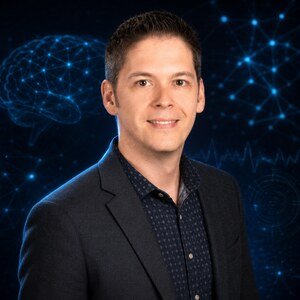 MD
MDDr. Moritz Dannhauer, PhD
Faculty member at East Carolina University whose research centers on computational modeling and electric-field–informed precision targeting for transcranial magnetic stimulation. His work bridges Synaptiq Neurotech’s technology development with rigorous academic neuroscience and biomedical computing.
Let’s build what’s next in neuromodulation.
For partnership, licensing, and research-collaboration inquiries.